Where does data-center cooling water go?
Follow heat and water through an evaporative cooling system—and see why global recycling does not erase local water use.
Water can change form
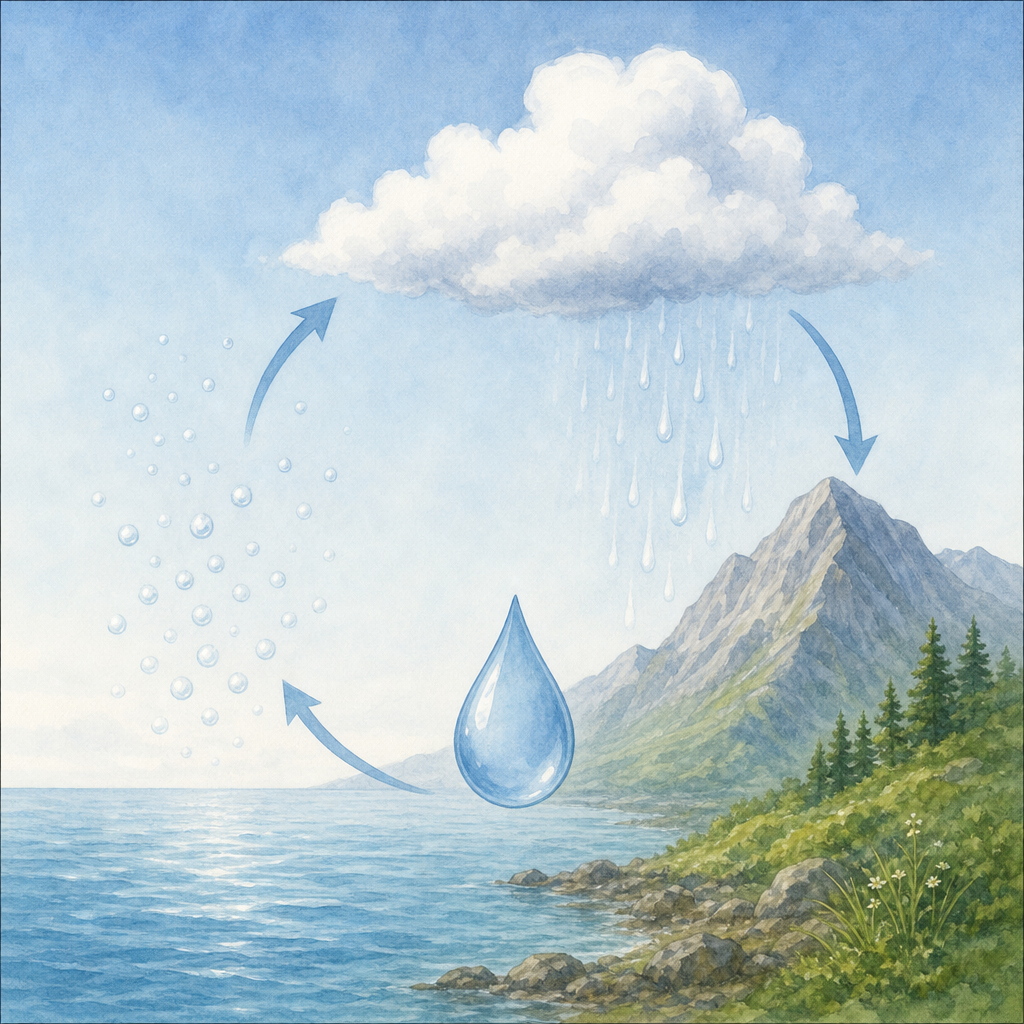
Water can be liquid, ice, or an invisible gas called water vapor. Heating liquid water helps some molecules escape into the air. That change is evaporation. The molecules are still water; they have moved and spread out.
Evaporation carries energy
Liquid molecules attract one another. The fastest molecules can break away from the surface when energy is available. They become water vapor and carry energy with them. The remaining liquid is cooler. Nothing was destroyed: matter changed location and phase, while energy crossed the boundary.
Latent heat makes evaporation useful
Evaporation requires latent heat: energy used for a phase transition rather than a temperature rise. When water molecules enter the gas phase, they carry this energy away from the liquid and its surroundings. This creates useful cooling. Mass is conserved, but a local system loses both vapor mass and energy unless that vapor is captured and condensed inside the same boundary.
Computers make heat
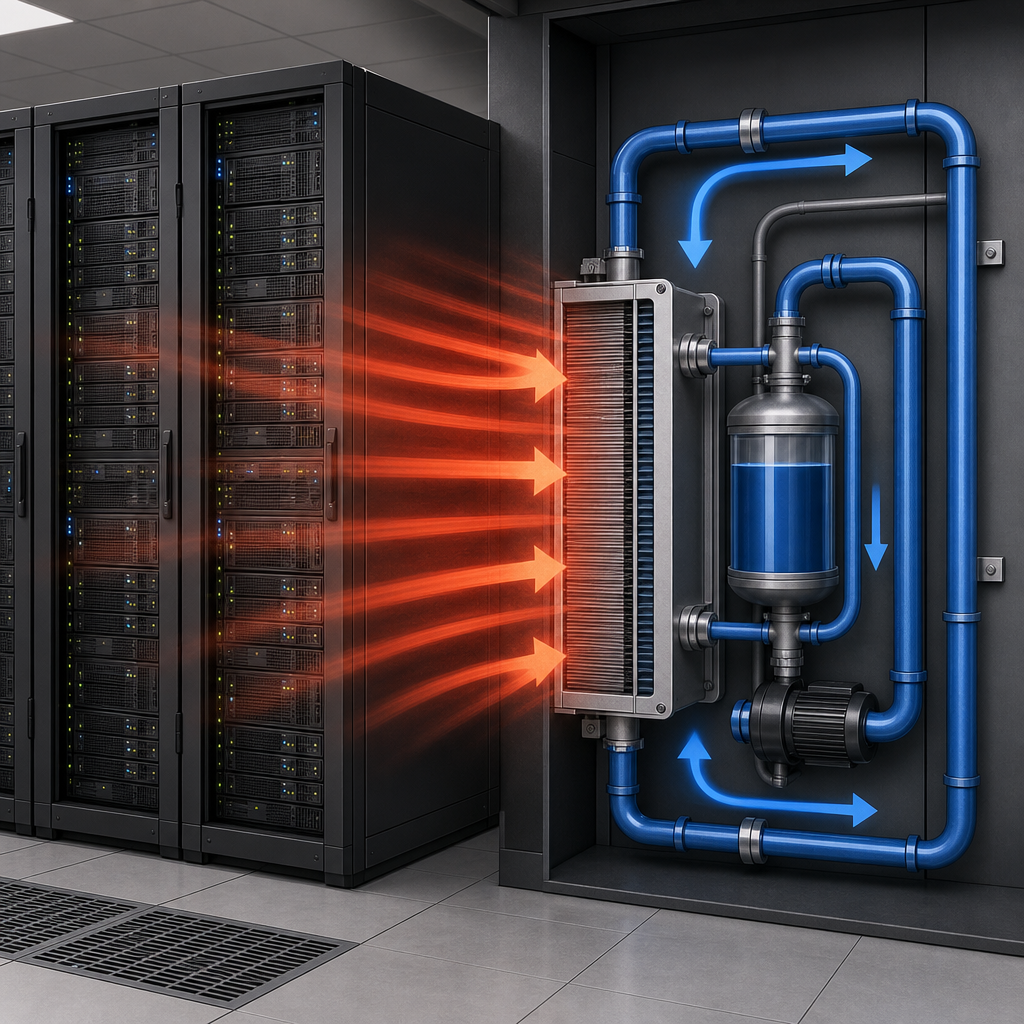
Thousands of computers work inside a large data center. Electricity lets them calculate, but much of that electrical energy ends up as heat. Fans and pipes move the heat away from delicate equipment. The heat must finally go somewhere outside the building.
Cooling is a chain of transfers
Heat flows from electronic parts to air or liquid, then through one or more heat exchangers. Pumps and fans keep those fluids moving. A cooling tower can be the final step: it transfers heat to outdoor air by evaporating a small part of its circulating water.
Separate loops move heat safely
Many facilities isolate equipment, chilled-water, and condenser-water circuits. Heat exchangers transfer energy between these loops without mixing their fluids. The condenser loop carries the combined IT heat and cooling-system work to a tower. There, contact between water and air enables heat and mass transfer. Pumps and fans add energy, but the fluid loops keep sensitive equipment separated from outdoor water.
Some water leaves as vapor
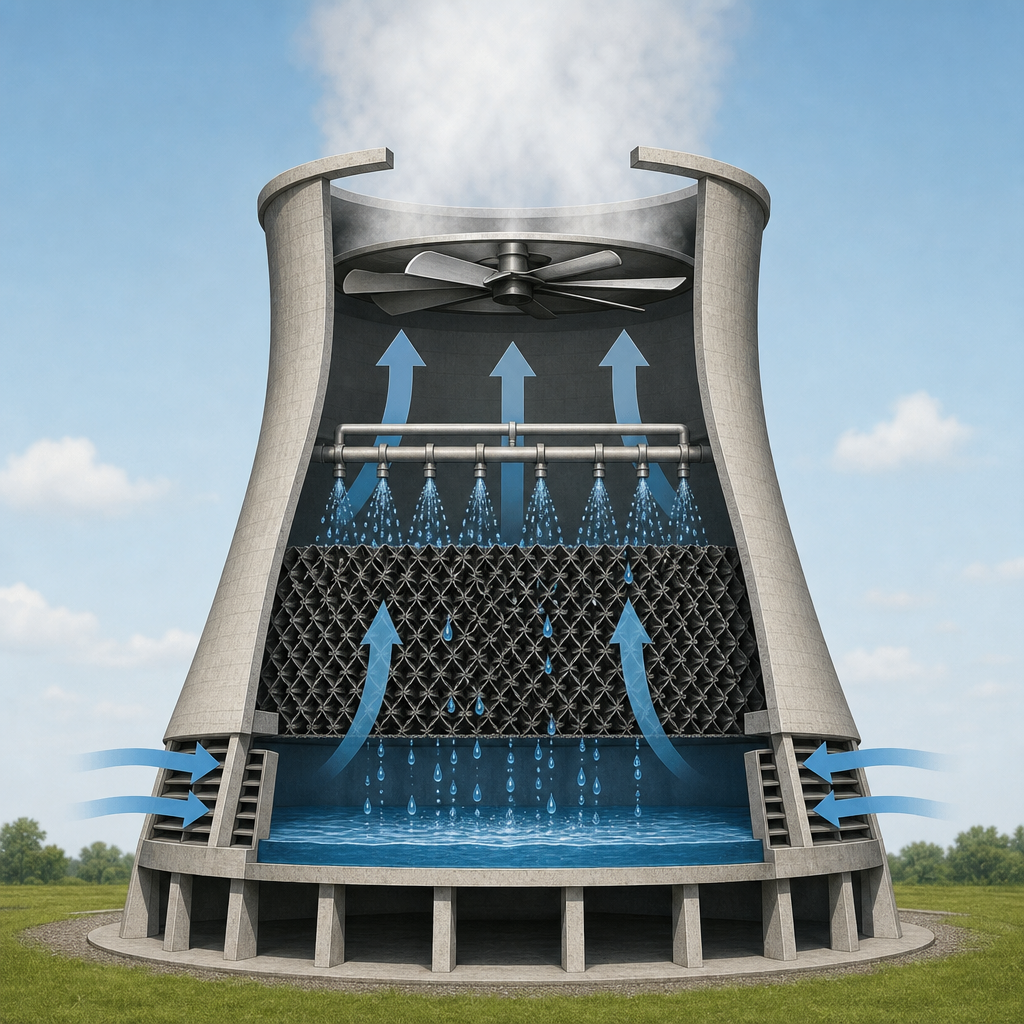
Inside the tower, air passes over warm water. A small part evaporates and takes heat into the air. Most liquid water falls back and circles around again. New water replaces the vapor that left. Some extra water is drained because minerals stay behind.
Why evaporation can cost less energy
Evaporation can reject large amounts of heat without relying entirely on compressor-driven refrigeration. In suitable weather, that can reduce electricity use and equipment needs. It is not free: pumps and fans still run, water must be supplied, and treatment and maintenance are required. The best choice depends on climate and local resources.
An energy–water trade-off
Evaporative heat rejection exploits water’s high latent heat, often lowering compressor work compared with fully air-cooled mechanical systems under the same conditions. Capital and operating costs can therefore fall, especially at large, steady loads. Yet the comparison is site-specific: wet-bulb temperature, electricity price, water price, water quality, regulation, reliability targets, and alternative cooling designs can reverse the result. “Cheaper” is not universal.
Not gone, but no longer here
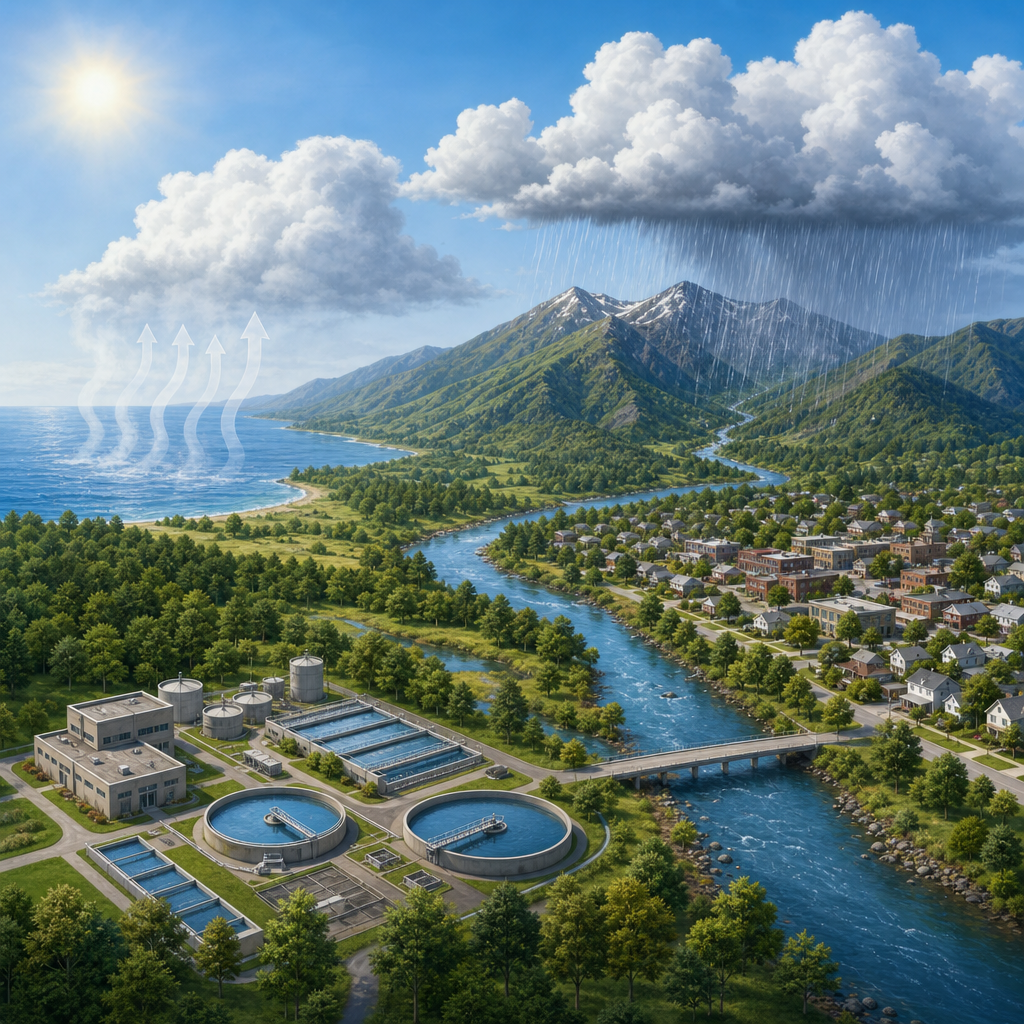
The vapor joins the air and may later form clouds and rain. No water molecules were erased. But they may fall far away or much later. People near the data center cannot immediately use that vapor, so the local lake, river, or water supply can still lose available water.
Global recycling does not cancel local use
Earth’s water keeps circulating among oceans, air, soil, ice, rivers, organisms, and groundwater. Evaporated cooling water remains in that cycle. Yet water management is local and time-sensitive. Vapor that returns as rain in another watershed does not immediately refill the original source. Cleaning, pumping, storing, and sometimes desalinating replacement water also require infrastructure and energy.
Conservation of mass and consumptive use coexist
At the planetary scale, ordinary evaporation conserves water molecules; they move through atmospheric transport, condensation, and precipitation. At a facility or watershed scale, evaporation is consumptive use because withdrawn liquid is not promptly returned to the same accessible source. Blowdown is different: it leaves as mineral-concentrated liquid and may enter wastewater treatment. Responsible comparison therefore tracks withdrawal, consumption, discharge quality, timing, watershed stress, and indirect water used to produce electricity—not merely global molecular conservation.
Sources
- Cooling Water Efficiency Opportunities for Federal Data Centers — U.S. Department of Energy
- Evaporation and the Water Cycle — U.S. Geological Survey
- What is the Earth's water cycle? — U.S. Geological Survey